Friday, December 4, 2015

The Vegetable


Throughout the entire autobiography The Complete Persopolis, Marjane faces many differents conflicts. She finds a minor conflict with her parents when they send her away, God when her uncle is executed, her failed relationships, her landlords, etc. However, in my very own opinion, I believe that she has the biggest conflict with herself. She had trouble finding out who she was and even coming to the end of the story, she seemed to only know that she did not want to stay in Iran.


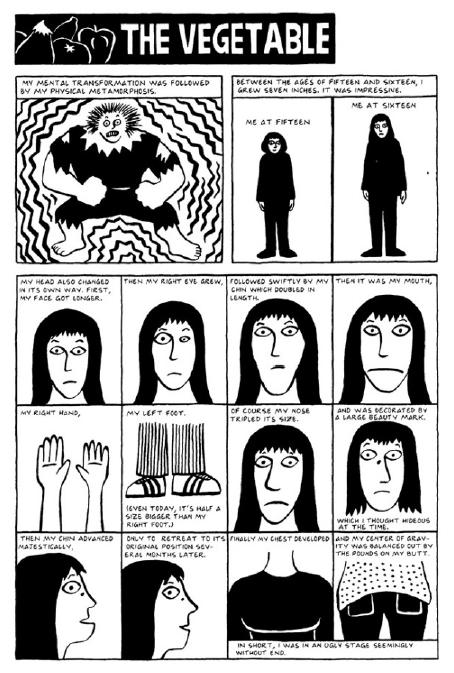
On page 189, Marjane is shown going through numerous amounts of changes due to puberty. Her head, her feet, her eyes, her chin, her mouth, her nose, her butt, and her breasts all advanced (Satrapi 189). “As if my natural deformity wasn’t enough, I tried a few new haircuts. A little snip of the scissors on the left…and a week later, a little snip of the scissors on the right.” During this period, it is clear that Marjane is trying to find some new identity. She gels up her hair and with this new look, she even tells a man that she is French instead of Iranian (Satrapi 195).


Marjane has a habit of losing herself. Not only did she lose herself and forget who she was when she denied her nationality, but when she began to do drugs. When she met her boyfriend, Markus, they always smoked together. With that relationship and some connections, a drug-dealing job stemmed. “What do you want me to say sir? That I’m the vegetable  that I refused to become?...that I hate myself? (Satrapi 226).” She even says, “I should say that I was smoking too many joints. I was constantly tired and I always fell asleep.” This is when Marjane’s huge obsession and depression begins. This follows to be one of her largest self conflicts.

Monday, November 30, 2015

Family Matters


It is made clear on multiple occasions that Marjane Satrapi, author of The Complete Persepolis, values religion. She speaks of wanting to become a prophet when she gets older (Satrapi 6) and how everything would be okay because God picked the king (Satrapi 19). However, it is also obvious that she values her family, as well—maybe even more than religion. Though, on page 19-20, Marjane chooses her faith over her father’s words after an internal debate with herself, she shows loyalty to God.

On page 13-17, Marjane’s faith is tested. She asks for God when something bad happens, as told by her father, and he doesn’t show up. That leaves her no choice but to side with her parents about the evil being caused and the war/demonstrations rising up.

It is truly proven that her family is important to her when her uncle shows up in the picture. Her uncle was the hero that Marjane had been looking for in a family member, just like her friend’s dad. They’d grown close and she didn’t need to talk to God anymore, it seemed, for she only wanted to talk to her new idol. She’s heard a multitude of political discussions (Satrapi 62) and murders have occurred during Uncle Anoosh’s stay (Satrapi 65). She was revealed and introduced to a whole new world that she had once known nothing about.

When her uncle died of execution, Marjane shunned God for good. He was not there when she needed him (Satrapi 70).


What other things are valued by Marjane? How do her values shape who she is?

Tuesday, November 24, 2015

Black Friday


"We had demonstrated on the very day we shouldn't have: on 'Black Friday.' That day, there were so many killed in one of the neighborhoods that a rumor spread that Israeli soldiers were responsible for the slaughter." (Satrapi, 39). 

September 8, 1978, known as "Black Friday,"  was the beginning of the end of the Shah's regime and the Pahlavi Dynasty. It was a day that irrevocably changed the course of history in Iran and the Middle East. Many cities were under martial law by decree of Mohammad Reza Shah. Many citizens defied the Shah's orders and took to the streets in protest, a common occurrence throughout 1978 Iran.


In the United States, among other places, “Black Friday” is known as the day after Thanksgiving. It is a day when all or most stores have sales online or in store for the purchase of Christmas, or other holiday, gifts. Is the term “Black Friday” used too lightly? Past research talks about Black Friday having to do with slave trade, but even so—the term is labeled from two bad times in history, yet we use it to label discounts and clearences. Isn’t that insanity? Before reading Persepolis and seeing how tragically awful the Black Friday massacre was, I had no knowledge of it. To me, I feel insulted each time I hear the term anymore.

The lack of knowledge of this war is sickening. A government against its people that resulted in many murders is something that should not be slept on by us and is something that a little girl, like Marjane, shouldn’t have endured. Respect is lost and I believe this could be a major ongoing conflict for the book’s main character and many others who survived that day.

Wednesday, November 4, 2015

The Tree's Roots

In this novel, there are many minor characters, yet their presence seem to hold the pages together; the storyline would be nothing without these characters. Then, there’s the protagonist, Hazel Grace, who seems to dominate the novel, considering she narrates it. She’s the star of the book and she makes the book worth reading. However, I fail to see how she is the most important character in The Fault in Our Stars. Yes, she was important and yes, the story would be nothing without her. She’s the base of the tree but in my opinion, Augustus Waters proved to be the roots.
                Before Augustus makes his first appearance, Hazel’s life has no meaning and she seems to only attempt to live for the sake of her parents and to make them happy. There was no purpose. Augustus has changed her life profoundly and if he had never blessed the novel with his presence, its pages would also have no meaning, no purpose. It would be a boring novel about a girl with cancer and it would have no bigger purpose and a big waste of time. Green knew this and so Augustus Waters quickly soared to the top of the “best character” list for the book, The Fault in Our Stars.
                "‘Why are you looking at me like that?’ Augustus half smiled. ‘Because you're beautiful.’" (1.89-90). When Augustus speaks these words, Hazel Grace is met with something foreign. In the first few chapters of the book, the protagonist points out how she is not a normal teenager and that she hasn’t been normal since before her diagnosis. With his words, Augustus brings out a newfound confidence that Hazel has never before experienced. She’s never felt this way and she ends up liking the feeling and she doesn’t attempt to hide it with her excessive, nervous giggling and her obvious, pink blushing. Augustus essentially shows up and “rescues” Hazel from all the drudgery of being a cancer kid, and in return, Hazel’s whole entire attitude changes.
                In general, those who are diagnosed with cancer immediately think the worst, as Hazel does quite frequently with her pessimistic attitude. However, Augustus strays from the “cancer kid” stereotype. He’s positively optimistic about every little thing in life. "‘I fear oblivion,’" he said without a moment's pause. "‘I fear it like the proverbial blind man who's afraid of the dark.’" (1.56). He doesn’t want to die without leaving some sort of mark on the world and though people can’t help but laugh at him for it, he isn’t afraid to shout it to the world. At first, Hazel doesn’t seem to be about it. Her pessimism clashes with his optimism often. Augustus never lets it falter, however, and though she might not have wanted it at first, Augustus was the perfect person for her. She needed him to lift her spirits and give her a reason to live. Even past his death, his bright attitude seemed to die and reincarnate in Hazel.

                Hazel is an important character but Gus gives the book character and meaning. He teaches lessons and he lifts the spirits of readers.

Friday, October 30, 2015

Hazel Grace Slothcaster

In the novel, The Fault in Our Stars, the protagonist is Hazel Grace Lancaster, who is a cancerous teenage girl with a pessimistic mind and an avid love of books. I think that if Hazel was an animal that she would be best portrayed by a sloth. A sloth is slow and disconnected and it prefers to be alone. Hazel is alike in this way for the simple fact that she isn’t like her classmates due to her illness. When her disease grew severe, she dropped out of school and even the only friends that she managed to make in her couple years of high school seemed to fall out of touch.  Even when she meets with her friend, Hazel is shown to be disconnected and uncaring. She also isn’t the only one who notices her differences. Augustus notices it as well, but instead in a new light. "Goddamn," Augustus said quietly. "Aren't you something else." (1.66). In the eyes of Augustus, she truly is unique and like the sloth, Hazel is an odd character with a sort of charisma about her that you can’t help but love. As the reader, I’d have to agree with Augustus in this situation.
Hazel is guarded and defensive, but seemingly passive and uncaring. However, I hardly believe that to be true. A sloth could be seen as slow and relaxed but if they weren’t fighters, how could they still be strategic survivors?  There is only one thing in this world shittier than biting it from cancer when you're sixteen, and that's having a kid who bites it from cancer. (1.28) This quote doesn’t exactly prove the fact that she’s strong but it disproves the fact that she won’t fight for her life due to her physical capability. In fact, she is fighting for her life. She’s doing it for her parents. And that makes her stronger than ever. Before Augustus started attending the support center in the “literal heart of Jesus,” Hazel hadn’t spoken in the group, or even had the remote interest in doing so. This also is a good example of the wall that Hazel Grace has put up around people she isn’t fond of. Like any animal, sloths are very careful when choosing their company. They’ll hide from anyone who could potential bring them harm.

There are many animals that could be related to Hazel. However, in my eyes, the protagonist can be seen as sluggish and tiresome. She has a greater purpose to society, though she chooses to stay relaxed and undercover as if her existence would be harmful instead of helpful. Hazel isn’t living to live. She’s living because she has to and because it’d help everyone but her. In the animal kingdom, living is work. Animals don’t have paying jobs and wealth; they work the same job of survival and aim to only do just that. Hazel has her GED and attends college classes but probably doesn’t even plan to live long enough to do anything with those abilities. Just like a sloth, she’s just trying to figure out what to do to keep herself breathing.

Thursday, October 22, 2015

An Imperial Irony

The book, The Fault in Our Stars, could’ve had a much better, more conclusive ending. While I’m not, in any way, degrading Mr. John Green’s writing, there are ways that could’ve better summed up things. In the novel, Green’s main character, Hazel Grace, is obsessed with a book called An Imperial Affliction by Peter Van Houten. Hazel drones on and on about how the novel ends mid-sentence and how she wishes she could somehow figure out a way to know what happens to the other characters written in Van Houten’s book. I can’t help but wonder the same thing about The Fault in Our Stars. Yes, I understand that Augustus Waters, Hazel’s cancerous boyfriend, dies and Hazel is okay with it and that was supposed to be the ending. However, there was no more on the two families and the youth group and Issac. I’m aware that a book has to end at some point but this was just not how. Ending a novel with a letter written to Van Houten from Augustus about Hazel Grace wasn’t a conclusion to anything but the fact that Augustus did indeed love her.
At the end of the novel, Lidewij sends Hazel Grace the letter that Augustus writes to Peter via email. Peter specifically explains to his assistant that he has nothing else to add, but I completely disagree. The letter itself was mediocre, but ends with “I like my choices. I hope she likes hers.” (Green, 313). Hazel then girls the monologue of a response: “I do, Augustus. I do” And then that’s it. The book comes to a close and as a reader, I feel as though there should be more—there needs to be more. I wouldn’t even mind if the narrator went into a five paragraph explanation of why she felt she made good choices, but her simple response to this simple letter wasn’t enough to my curious and insatiable mind.

The book was great but the ending was incomplete. On page 282 of The Fault in Our Stars, Isaac’s last lines are spoken. Isaac was a good friend of Augustus’ and, in my opinion, proved to play an important role in the storyline itself. However, John Green chose not to give insight on how he felt post-death of his best friend. Was he sad? Of course he was, but it was not clearly expressed. He says, “Gus really loved you, you know” (Green, 281), which is something completely irrelevant to his own feelings. The fact is that  Isaac has known Augustus longer than Hazel and despite whatever relationship the two cancerous teens shared, Isaac shouldn’t be used as the character that makes the protagonist feel better. He has feelings, too, and it is clear that John Green fails to admit that through his writing. This all brings me back to my main point of there not being any clarification of the other characters and their future. He barely even discusses the future of Hazel Grace. I find it to be very hypocritical of Green to complain about a loose ending when he, himself, fails to tie up the ends of his own novel.